

Step 1
Check in
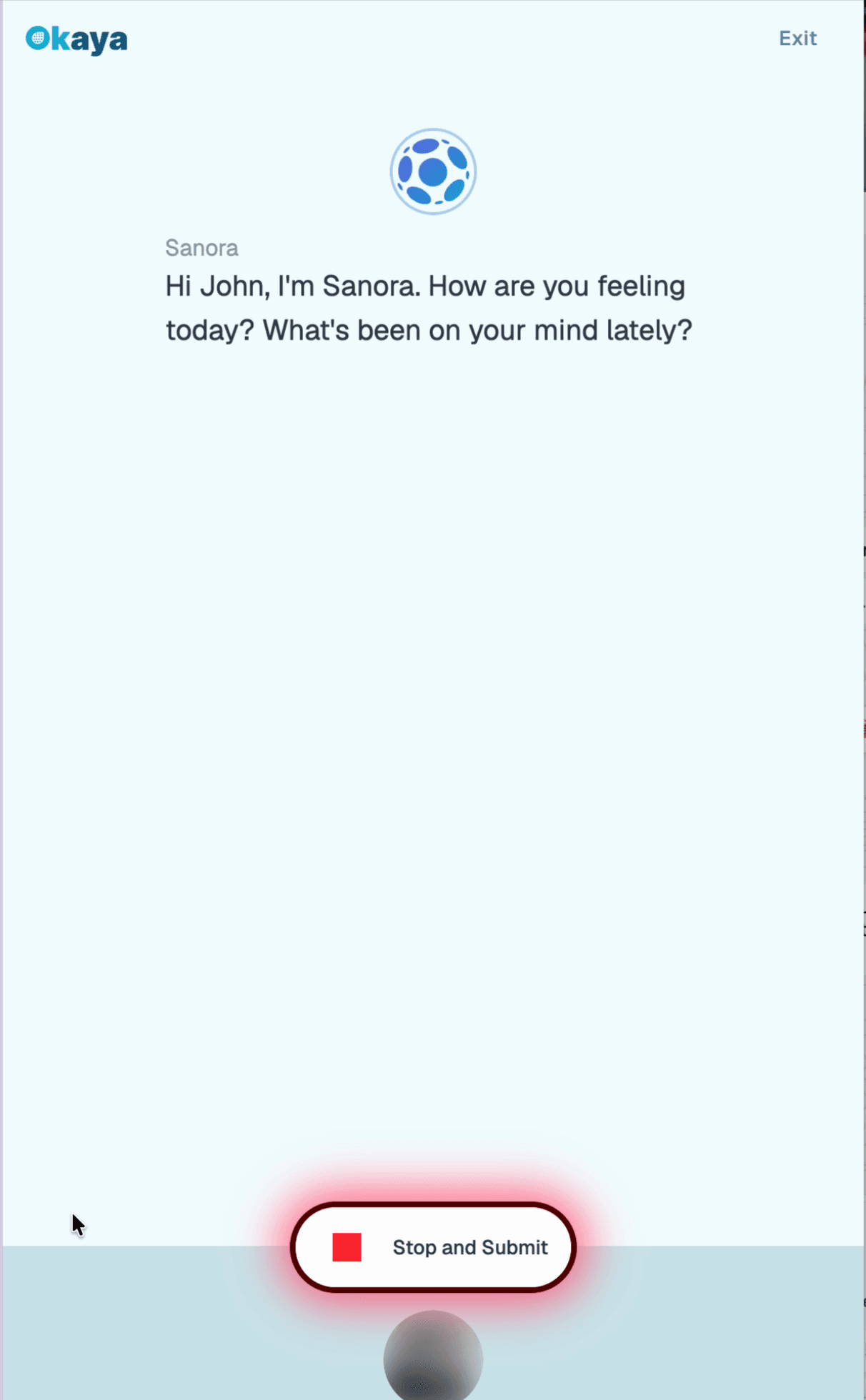
Each member talks with Sanora, Okaya's AI guide, for about 3 minutes on their own phone or laptop. No device to issue, no app to install.
For federal teams in high-consequence work, and the leaders who run them. Today, readiness runs on self-report and schedule rules. Okaya adds a read compared with each person's own baseline, so leaders can see the trend for their team. Our track record is with the U.S. Air Force and U.S. Space Force.
SBIR Phase II complete with an active U.S. Air Force flying unit. Any federal agency can award a Phase III sole-source order.
Research and contracts withU.S. Air ForceU.S. Space ForceJMIR Formative ResearchACM IUI 2026
Each member talks with Sanora, Okaya's AI guide, for about 3 minutes on their own phone or laptop. No device to issue, no app to install.
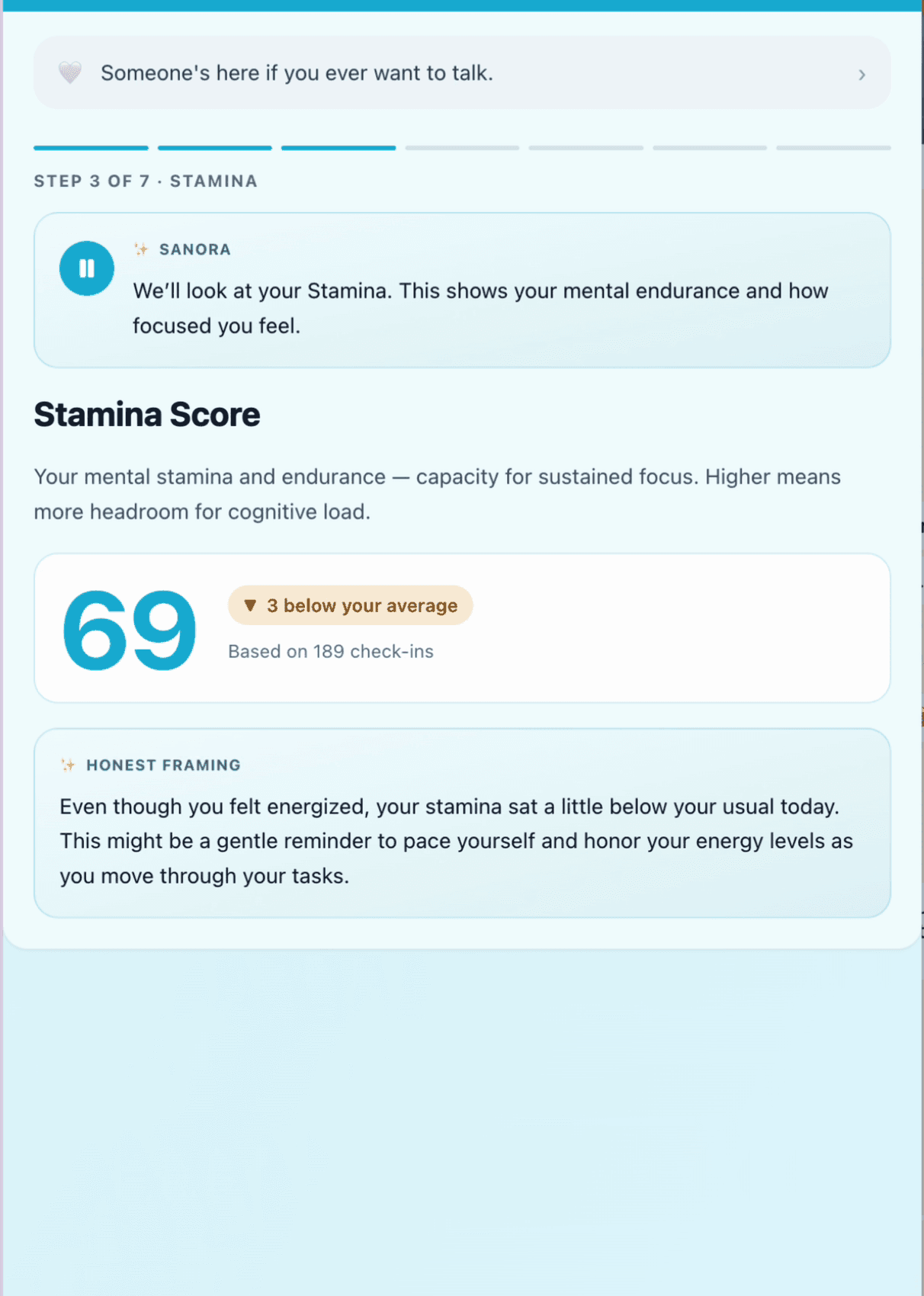
Okaya compares how the member sounds, what they say and how their expression moves today with their own earlier check-ins. It scores readiness against that baseline. A feasibility study with U.S. Air Force and U.S. Space Force participants found preliminary links between check-in signals and standard measures of fatigue and cognition. It uses points from the face, not a video.
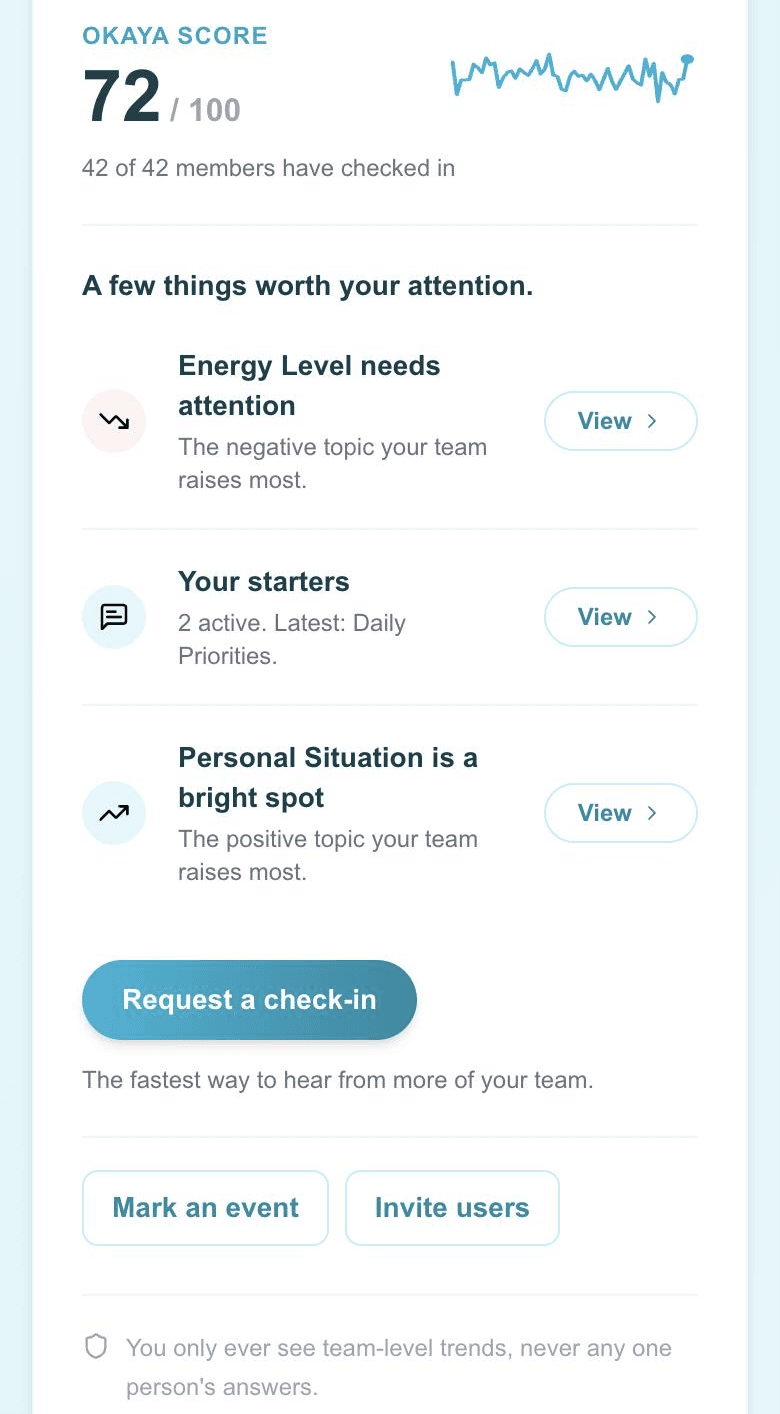
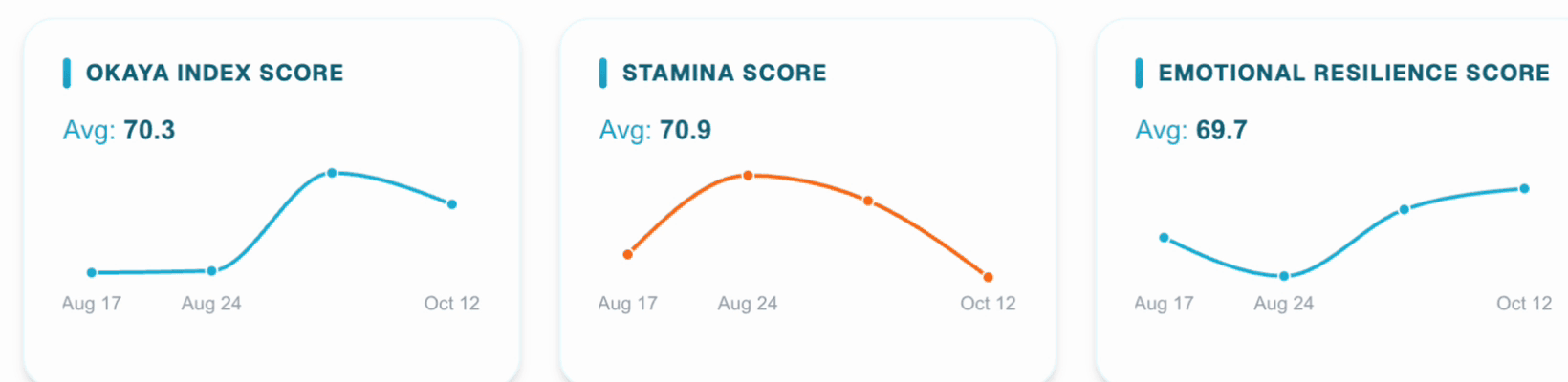
Team averages for readiness, stamina and emotional resilience, week by week.
Individual results stay private to the individual.
Leadership sees anonymized, aggregated unit-level readiness only. Never who checked in, how anyone did, or anything they said.
A leader cannot see who checked in.
The video never leaves the device. No facial identification capability.
A check-in never goes in a personnel record or a medical record, and is never part of an assignment or clearance decision.
Every decision about duty and assignment stays with your staff.
For unions and associationsIf a check-in raises a safety concernThe science
| Today | Trade-off | With Okaya |
|---|---|---|
| Self-report and schedule rules | Subjective; no baseline; no trend | A signal against the member's own baseline, about 3 minutes, any shift |
| Wearables and sleep-model fatigue software | Hardware to issue, charge and lose; sleep is one input | No hardware; vision, voice and language in one check-in on the member's own device; U.S. patent pending (non-provisional and PCT filed) |
| Medical, resilience and peer support staff | Reached after the fact, one person at a time | Unit-level trend week by week; staff keep the decisions; individuals keep their results |
The program lead decides whether the unit needs Okaya. The contracting officer signs the order. This is how an agency buys it.
We agree on the team, the goal and a start date for a 90-day trial. No ATO is needed, and first check-ins start within 15 days of the order.
An SBIR Phase III sole-source order under 15 U.S.C. 638(r), a SpaceWERX or AFWERX TACFI award for Air Force and Space Force units, or a commercial license.
One page with past performance, contract vehicles, NAICS codes and compliance. See the contracting facts
One page with past performance, contract vehicles, NAICS codes and compliance.
SBIR Phase I, FA864921P0971 (USAF).
Pilot with an active U.S. Air Force flying unit, SIF-funded. The After Action Report confirmed operational viability and led to the Phase II award.
Direct-to-Phase II, FA864924P0008. AFWERX, AFRL oversight. Readiness assessment integrated into the unit's pre-flight risk management. Nine milestones delivered; contract complete.
USSF Space Launch Delta 30, FA461026P0055. Three-month squadron readiness trial at Vandenberg SFB.
SBIR Phase III sole-source award available to any federal agency.
Sanora, Okaya's AI guide, runs the check-in conversation.
Models score readiness against the member's own baseline. A feasibility study found preliminary links to standard measures of fatigue and cognition.
People make every decision.
Okaya is a commercial readiness platform. Each member checks in for about 3 minutes on their own phone or laptop. Okaya scores readiness against that member's own baseline. A feasibility study found preliminary links to standard measures of fatigue and cognition. Individual results stay private to the individual; leadership sees anonymized, aggregated unit-level readiness only. Never who checked in, how anyone did, or anything they said. The U.S. Air Force awarded Okaya SBIR Phase I and Phase II contracts, and any federal agency can award a Phase III sole-source order.
Through an SBIR Phase III sole-source order under 15 U.S.C. 638(r), building on Phase II contract FA864924P0008. Any federal agency can award it.
No. Individual results stay private to the individual. Leadership sees anonymized, aggregated unit-level readiness only. Never who checked in, how anyone did, or anything they said.
The video never leaves the device. The phone extracts the facial landmarks. The landmarks and the voice audio go to the server, where the analysis runs. Okaya has no facial identification capability.
No. Okaya is not a medical device and needs no FDA clearance. A check-in never goes in a personnel or medical record, and every decision about duty stays with people.
90 days on the commercial platform, on members' own phones or laptops. First check-ins start within 15 days of the order.
No ATO is needed. Members check in on their own phones or laptops.
Yes. A SpaceWERX or AFWERX TACFI award, with a government match on an O-6 collaboration agreement, can fund a deployment. The GovCloud deployment sits inside the award.
On AWS. A dedicated AWS GovCloud deployment is available inside a funded award.
A 20-minute call, no prep needed. Or start with the one-page capability statement.