The Silent Alarm: Why Firefighters Stay Quiet
In short
Most firefighters don't ask for help because they fear being seen as weak or unfit, and many don't trust their department's EAP. The silence shows up as fatigue, errors, injuries and people who leave. Peer support, clinicians who know the fire service and a private way to check in early are what crews say they will use.
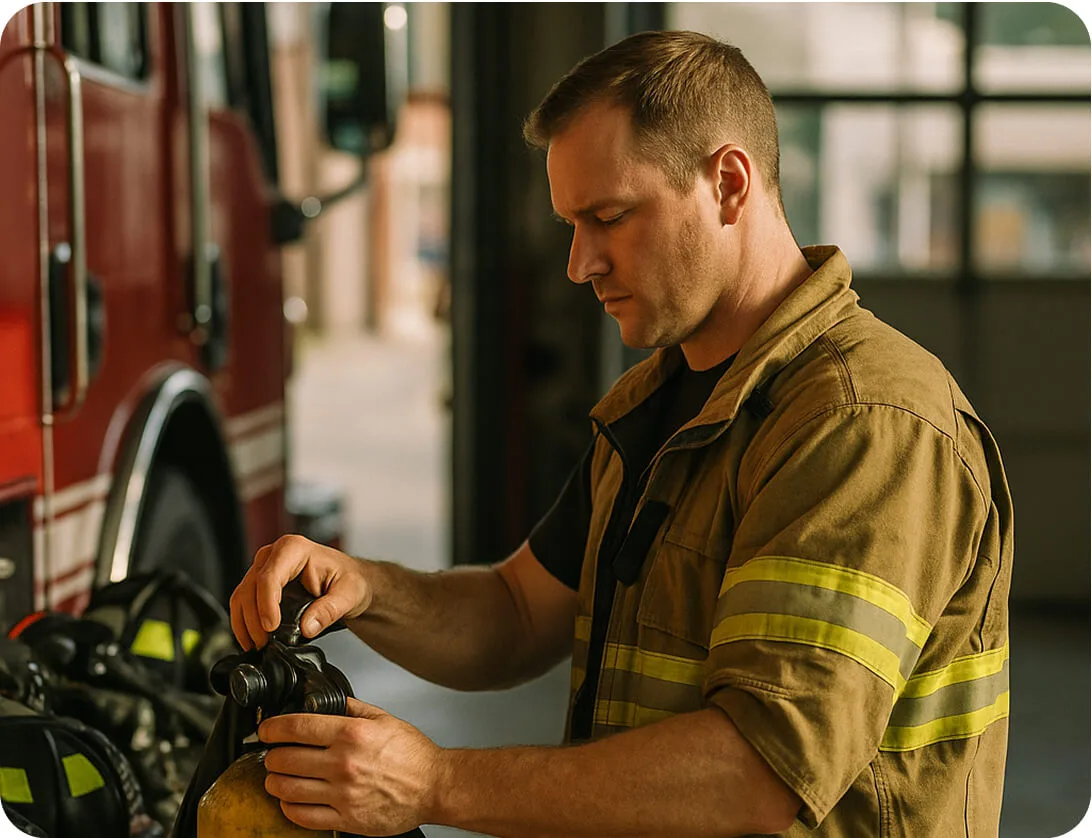
Firefighters stay quiet because asking for help feels like a risk to their standing and their job. In a survey of 7,000 firefighters run by NBC stations with the International Association of Fire Fighters (IAFF), 81% said they feared being seen as weak or unfit for duty if they asked for help (NBC, 2018). A department pays for that silence in fatigue, slower decisions, injuries and experienced people who leave. The help crews say they will use is peer support, clinicians who understand the fire service, and a private way to check in before things get bad.
Why don't firefighters ask for help?
Most firefighters expect that asking will cost them, and the help on offer often doesn't fit the job. In the same NBC and IAFF survey, 71% had not used their department's employee assistance program (EAP) for job-related mental health issues, and 63% of those who had used it did not find it helpful (NBC, 2018).
In larger departments, access is usually there. In a survey of 2,156 career firefighters, 81% said their department gave them access to behavioral health services, yet 68% said they would not recommend those services to a colleague (Gulliver et al., 2019). The same firefighters rated "clinicians who understand firefighter work culture" as one of the most important parts of a program, and the lack of those clinicians as one of the biggest barriers. Asked where they would turn, most named a spouse or family member (67%) or a private professional outside the department (60%).
Smaller departments often have no program at all. In NFPA's Fifth Needs Assessment of the U.S. Fire Service, surveyed in 2020 and 2021 and the latest edition published, 73% of U.S. fire departments had no behavioral health program, and only 14% of the smallest departments had one (IAFC summary of the NFPA report, 2021).
What does the silence look like on a crew?
It usually looks like a good firefighter who gets slower and more tired, while the crew covers and nobody names it. The story below is a composite. "Jake" is not a real person, and no detail belongs to one firefighter. He stands for patterns that firefighters describe in the surveys cited here.
Jake is a lieutenant with 18 years on the job. After a fatal house fire where his crew could not reach a child, he starts sleeping badly and freezing for a beat on calls. His department has an EAP, but he doesn't use it. He doesn't trust that it's confidential, and he doesn't think the counselors know the work. His crew starts to compensate. On an apartment fire he misses a ventilation call, the engineer catches it, and nothing goes in a report.
None of this reaches the chief until it turns into a sick day, an injury claim or a resignation letter. By then the department has lost months in which a peer, a clinician or Jake himself could have acted.
What does the silence cost a fire department?
The cost shows up in slower decisions, more injuries and errors, and lost lives. Few studies put a dollar figure on stress alone, so each number below measures one part of the cost.
| Cost | What the research found | Source |
|---|---|---|
| Slower thinking | In 325 firefighters from eight departments in Korea, PTSD symptoms were linked to slower psychomotor and processing speed, through poorer sleep and lower resilience. | Han et al., 2021 |
| Injuries and errors | In 547 EMS providers from 30 agencies, fatigued providers had 1.9 times the odds of injury, 2.2 times the odds of a medical error or adverse event, and 3.6 times the odds of safety-compromising behavior. | Patterson et al., 2012 |
| Injury cost | Firefighter injuries cost an estimated $1.6 billion to $5.9 billion a year in the U.S., about $1,500 to $5,500 per firefighter per year. This covers all injuries, including those with no link to stress or fatigue. | Butry et al., NIST, 2019 |
| Suicide | At least 103 firefighters died by suicide in 2017, against 93 line-of-duty deaths that year. | Ruderman Family Foundation, 2018 |
| Suicidal thoughts | In 1,027 current and retired firefighters, 46.8% reported suicidal thoughts at some point in their career. | Stanley et al., 2015 |
The EMS study matters to fire chiefs because many departments run EMS, and a tired provider on a medical call carries the same kind of risk as a tired firefighter on the fireground.
What works for firefighter mental health?
What works is help that firefighters trust: trained peers, clinicians who know the job, training that treats the mind like fitness, and a private way to check in early. Some of these have outcome data. Others rest on what firefighters say they want.
Peer support. A 2023 review of 13 studies of peer support for public safety workers found that confidentiality, trust and shared experience made programs work, and that stigma was the main barrier to joining one. Workers said peer support helped them see their reactions as normal and reduced stigma (Fallon et al., 2023).
Clinicians who know the fire service. Firefighters rank cultural knowledge near the top of what they need from a clinician (Gulliver et al., 2019). The Fire Service Psychology Association publishes a cultural competency program for clinicians (FSPA, 2023). For IAFF members, the IAFF Center of Excellence for Behavioral Health Treatment and Recovery treats PTSD, substance use and related conditions.
Mental readiness training. The Road to Mental Readiness program was tested with five first-responder groups across 16 sites. Participants reported more resilience and less stigma after the training, and most of the change held at three months (Szeto et al., 2019). The IAFF/IAFC Wellness-Fitness Initiative already counts behavioral health as part of a firefighter's health, so this training can sit next to fitness in a program you already run.
Programs with a measured return. In four Oregon fire departments covering 1,369 firefighters, a 12-session, peer-led health promotion program cut workers' compensation claims and medical costs, with a return of $4.61 for every $1 spent (Kuehl et al., 2013). That program, PHLAME, targeted physical health. For behavioral health care, a 2025 study of 13,990 employees found that every $100 spent on an enhanced employer benefit cut medical claims by $190 (Hawrilenko et al., 2025). Those employees were not firefighters, so read it as a direction for your department and expect your own numbers to differ.
A private way to check in. Firefighters fear being seen as unfit, so the first step has to be one that only they see. Okaya is one option. It is a short, private check-in: you talk with Sanora for about 3 minutes, and it compares how you sound, what you say and how your expression moves today with your own earlier check-ins. It uses points from your face, not a video of you. Okaya never identifies who you are from your face. There is no facial recognition. Individual results stay private to the individual. Leadership sees anonymized, aggregated unit-level readiness only.
How should a fire department start?
Start with what your crews will use, and measure the result. In an Ohio study, the people who built first-responder programs named an internal champion with broader support as key to getting a program moving (Fisher and Lavender, 2023).
- Ask your crews which kind of help they would use, and who they would trust to give it.
- Train peer supporters, and give them a licensed clinician to consult.
- Check your EAP for fire service experience. If it has none, build a referral list of clinicians who know the job.
- Add mental readiness training to the fitness program you already run.
- Before you start, write down your sick leave, overtime, injury claims and turnover, so you can compare a year later.
Key points
- In a survey of 7,000 firefighters, 81% feared being seen as weak or unfit if they asked for help, and 71% had not used their EAP for job-related mental health issues.
- 73% of U.S. fire departments had no behavioral health program in NFPA's latest published needs assessment.
- Fatigue links to more injuries, errors and unsafe acts, and firefighter injuries cost an estimated $1,500 to $5,500 per firefighter per year.
- Crews trust peers and clinicians who know the fire service, and a peer-led program in Oregon returned $4.61 for every $1 spent.
Sources
- NBC Washington and the IAFF, firefighter mental health survey, 2018. Link
- Gulliver S.B. et al. "Behavioral health programs in fire service: Surveying access and preferences." Psychological Services, 2019. doi:10.1037/ser0000222
- National Fire Protection Association, Fifth Needs Assessment of the U.S. Fire Service, 2021, as summarized by the IAFC. Link
- Han Y. et al. "Posttraumatic stress disorder symptoms and neurocognitive functioning in fire fighters." Comprehensive Psychiatry, 2021. doi:10.1016/j.comppsych.2021.152250
- Patterson P.D. et al. "Association between poor sleep, fatigue, and safety outcomes in emergency medical services providers." Prehospital Emergency Care, 2012. doi:10.3109/10903127.2011.616261
- Butry D.T. et al. "The economics of firefighter injuries in the United States." NIST Technical Note 2078, 2019. doi:10.6028/NIST.TN.2078
- Ruderman Family Foundation. "Police officers and firefighters are more likely to die by suicide than in line of duty." 2018. Link
- Stanley I.H. et al. "Career prevalence and correlates of suicidal thoughts and behaviors among firefighters." Journal of Affective Disorders, 2015. doi:10.1016/j.jad.2015.08.007
- Fallon P. et al. "Peer support programs to reduce organizational stress and trauma for public safety workers: A scoping review." Workplace Health and Safety, 2023. doi:10.1177/21650799231194623
- Fire Service Psychology Association. "Clinician training: Fire Service Cultural Competency Training Program." 2023. PDF
- Szeto A., Dobson K.S., Knaak S. "The Road to Mental Readiness for First Responders: A meta-analysis of program outcomes." Canadian Journal of Psychiatry, 2019. doi:10.1177/0706743719842562
- Kuehl K.S. et al. "Economic benefit of the PHLAME wellness programme on firefighter injury." Occupational Medicine, 2013. doi:10.1093/occmed/kqs232
- Hawrilenko M. et al. "Return on investment of enhanced behavioral health services." JAMA Network Open, 2025. doi:10.1001/jamanetworkopen.2024.57834
- Fisher M.P., Lavender C.D. "Ensuring optimal mental health programs and policies for first responders." Community Mental Health Journal, 2023. doi:10.1007/s10597-023-01121-1
- IAFF/IAFC Wellness-Fitness Initiative. Link
- IAFF Center of Excellence for Behavioral Health Treatment and Recovery. Link